
Minimum tax on discretionary trusts
The NFF welcomes the opportunity to provide feedback on Treasury’s consultation regarding the proposed introduction of a 30 per cent minimum tax on discretionary trusts from 1 July 2028. The
Agriculture is a powerhouse of the Australian economy. Farmers are the backbone of regional Australia and a major contributor to national prosperity. Australian agriculture, fisheries and forestry directly employs 308,000 people, accounting for 5.6% of rural employment and 2.1% of national employment in 2024–25.
The sector’s economic contribution continues to grow. The gross value of agricultural, fisheries and forestry production has increased by 45% over the past 20 years in real terms, from $69.3 billion in 2004–05 to $100.3 billion in 2024–25. Over the same period, the value of agriculture’s exports increased by 60% in real terms, from $47.5 billion to $75.8 billion. These figures reflect agriculture’s enduring role in strengthening the national economy, supporting regional communities and supplying the food and fibre Australians rely on every day.
Agriculture has also been one of Australia’s strongest productivity performers. While productivity growth has slowed across much of the economy over the past two decades, agricultural productivity has continued to outperform most other industries. This reflects the resilience, adaptability and innovation of Australian farm businesses, supported by world-class research, technology adoption and practical improvements in how food and fibre are produced.
But productivity on farm is shaped by more than what happens inside the farm gate. Farmers operate in a complex and highly exposed business environment. Their performance is influenced by seasonal conditions, global commodity markets, supply chain disruptions, the availability and cost of key inputs, access to capital, energy prices, and taxation and regulatory settings. These factors directly affect farm profitability, investment decisions and the sector’s ability to keep improving productivity.
That is why the National Farmers’ Federation (NFF) engages in economic and farm business policy. Well-designed policy settings are essential to help farmers manage risk, invest with confidence and continue lifting productivity. Conversely, poorly designed policy can increase costs, constrain investment and weaken the resilience of farm businesses and regional communities.
The NFF advocates for fair and sensible approaches to the policy areas that most affect farm business productivity and profitability, including taxation, competition, liquid fuel security, drought, energy policy, transport and infrastructure. Across these areas, the NFF’s focus is on ensuring farm businesses can remain profitable, productive and resilient — so agriculture can continue to deliver for Australia’s economy, regions and communities.
Australian farmers have always managed seasonal variability, but drought remains one of the most significant recurring risk for farm businesses.
Australia’s national energy policies must deliver affordable, reliable and secure energy while supporting the transition to a lower-emissions future.
With most of Australia’s food supply sourced from domestic farms, secure access to liquid fuels is essential to maintaining production and distribution across the national supply chain.
The NFF regards competition within the marketplace as a major driver of industry innovation, investment and international competitiveness.
Because agriculture plays an essential role in producing Australia’s food and fibre, it is important that the tax system recognises the operating realities of farm businesses
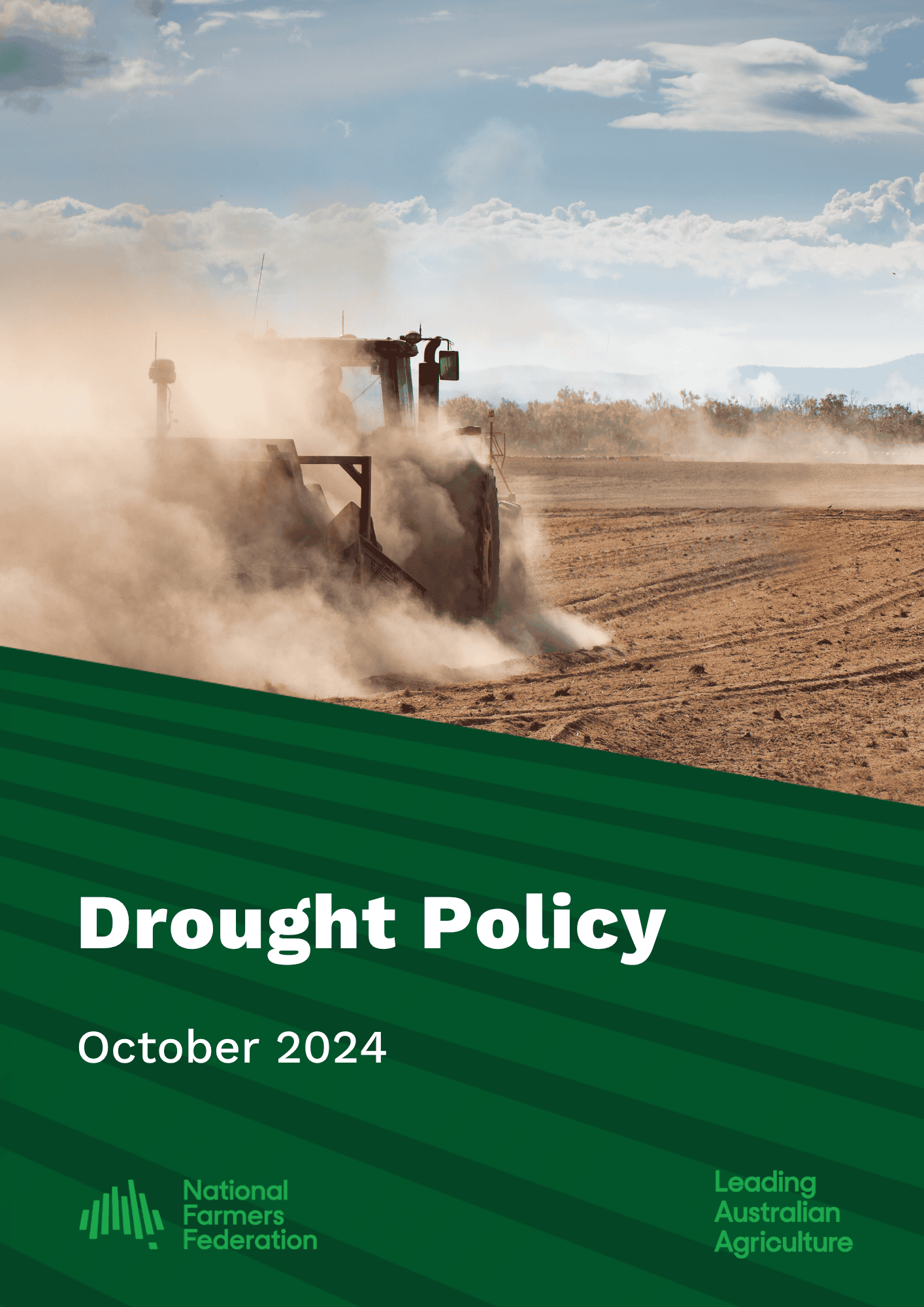
Drought is a fundamental characteristic of Australian landscapes and a long-term policy priority for the NFF. Australian farmers have always managed seasonal variability, but drought remains one of the most significant recurring risks for farm businesses, farming families and regional communities.
The NFF’s drought policy is built around the Drought Cycle: preparing for drought, managing through drought, and recovering from drought. This recognises that producers are responsible for their own business preparedness and invest significantly in resilience, while also acknowledging that some drought conditions extend beyond what farming businesses can reasonably withstand.
The NFF supports a comprehensive and enduring national drought policy, led by the Commonwealth in partnership with state and territory governments, industry and regional communities. Effective drought policy must provide certainty, coordination and flexibility, and be informed by science, data and practical on-the-ground knowledge.
The NFF continues to advocate for policies and programs that strengthen preparedness, support farmers during severe drought, and enable recovery. This includes ongoing investment through the Future Drought Fund, maintaining Farm Management Deposits and other risk management settings, access to concessional finance, and practical hardship, health, wellbeing and financial counselling support.
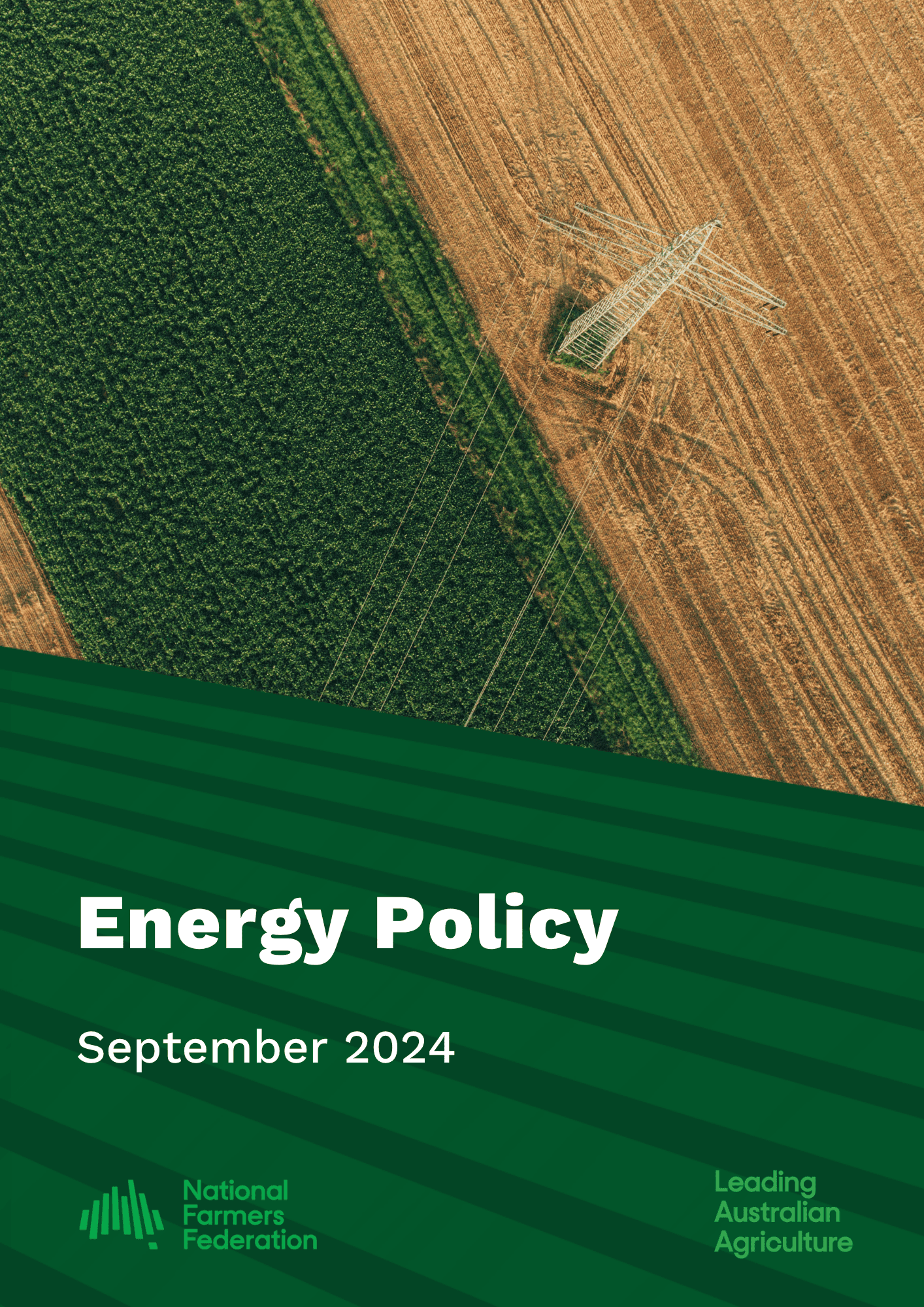
Australia’s national energy policies must deliver affordable, reliable and secure energy while supporting the transition to a lower-emissions future.
The NFF engages in energy policy because decisions about generation, transmission, pricing and regulation have direct consequences for farm productivity, business costs and regional development. Farmers and regional communities are also central to the energy transition, both as energy users and as hosts, partners and potential beneficiaries of new energy infrastructure and technologies.
As Australia transitions toward greater use of renewable and low-emissions energy, policy must be practical, technology-neutral and designed in partnership with affected communities. The NFF supports approaches that improve competition, encourage innovation, maintain reliability, and ensure landholders and communities are consulted, respected and fairly recognised for their contribution.
This policy is complementary to the NFF’s Climate Change Policy and reflects the organisation’s broader commitment to practical, economy-wide emissions reduction that supports agricultural productivity, strengthens regional resilience and creates opportunities for farmers and rural communities.
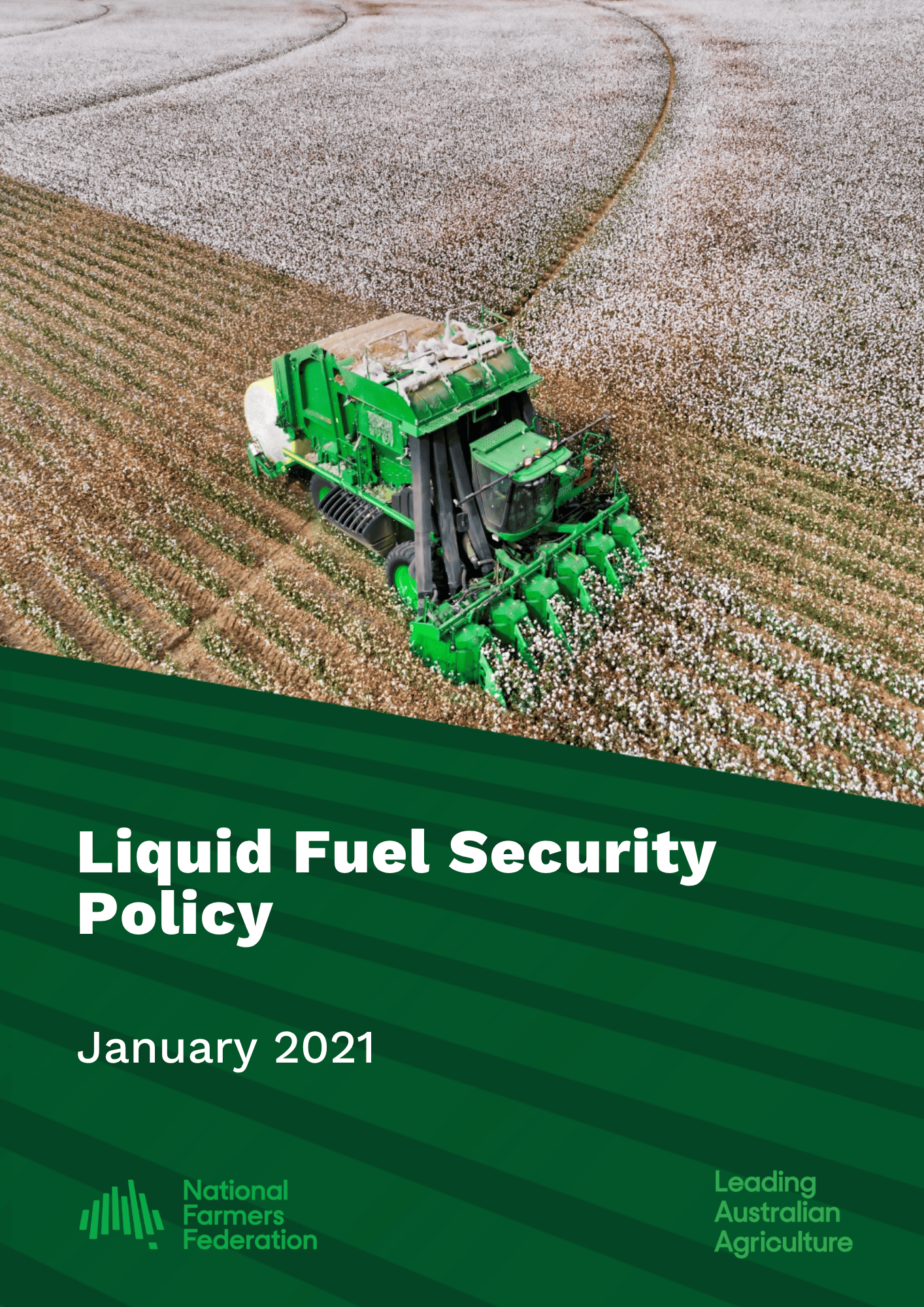
Diesel remains critical to Australia’s food, fibre, forestry and fisheries production. It powers the machinery, transport, irrigation, refrigeration and on-farm systems that keep agricultural businesses operating and enable produce to move from paddocks, ports and processing facilities to consumers.
With the majority of Australia’s food supply sourced from domestic farms, secure access to liquid fuels is essential to maintaining production and distribution across the national supply chain. Australia is highly dependent on international fuel supply chains, with a significant proportion of liquid fuel imported. This creates vulnerabilities when global shipping, refining capacity or domestic distribution networks are disrupted.
For farm businesses, even short-term shortages or sharp price increases can delay planting, harvesting, fishing, freight and processing, increase input costs and reduce the sector’s capacity to produce food and fibre for Australians.
The NFF engages on liquid fuel security policy to ensure the needs of agriculture are understood in national fuel planning and emergency response. Our focus is on identifying and addressing supply chain vulnerabilities so farmers, fishers and foresters can continue producing the food, fibre and materials Australians rely on.
The NFF regards competition within the marketplace as a major driver of industry innovation, investment and international competitiveness. It is critical that competition laws are effective at maintaining and improving competition across the agricultural supply chain.
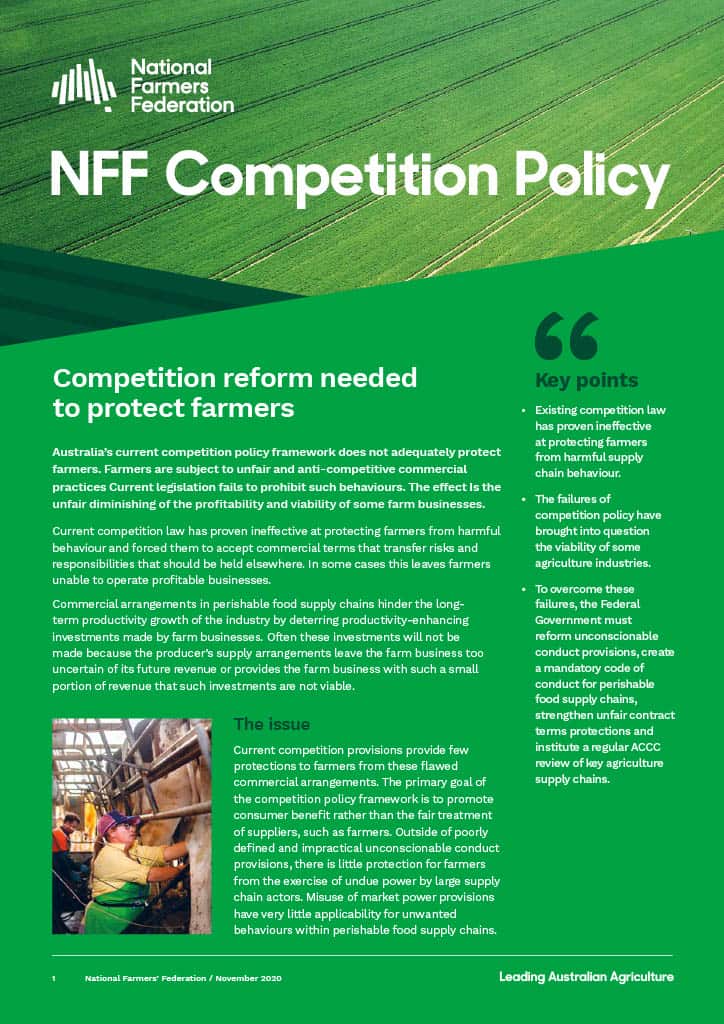
Australia’s current competition policy framework does not adequately protect farmers. Farmers are subject to unfair and anti-competitive commercial practices Current legislation fails to prohibit such behaviours.
The effect Is the unfair diminishing of the profitability and viability of some farm businesses. Current competition law has proven ineffective at protecting farmers from harmful behaviour and forced them to accept commercial terms that transfer risks and responsibilities that should be held elsewhere. In some cases this leaves farmers unable to operate profitable businesses.
Commercial arrangements in perishable food supply chains hinder the longterm productivity growth of the industry by deterring productivity-enhancing investments made by farm businesses.
Often these investments will not be made because the producer’s supply arrangements leave the farm business too uncertain of its future revenue or provides the farm business with such a small portion of revenue that such investments are not viable.
The NFF engages in taxation policy because tax settings directly affect the ability of Australian farm businesses to grow, invest and remain competitive. As the national peak body for farmers, NFF advocates for tax settings that recognise the way farm businesses operate and the essential role agriculture plays in producing Australia’s food and fibre.
Farm businesses operate through a range of structures, including sole traders, trusts, partnerships and corporations. They are also often described as “asset-rich, but cash poor”. In practical terms, this means many farm businesses hold most of their value in land, machinery and infrastructure, rather than in cash. As a result, a farm may be valuable on paper while still having limited capacity to meet new or higher tax costs.
Further, around 95 per cent of Australian farms are family-owned and operated and, by turnover, around 99 per cent of primary production businesses fall within the ATO’s definition of a small business, with less than $10 million in aggregated turnover. This means tax policy can have direct implications for the viability of family farm businesses, the ability of farmers to reinvest in their enterprises, and the way farms are transferred between generations.
These characteristics are why taxation settings are a long-standing focus of NFF advocacy. Tax settings have a direct bearing on farm business profitability, investment and long-term sustainability. Because agriculture plays an essential role in producing Australia’s food and fibre, it is important that the tax system recognises the operating realities of farm businesses, including their common business structures, high reliance on land and other fixed assets, and volatile income due to seasonal conditions and market fluctuations.
This is reflected in NFF’s advocacy on taxation measures that are important to the agriculture sector, such as Farm Management Deposits, the Diesel Fuel Tax Credit and the Instant Asset Write-Off. The NFF also engages in broader tax reform processes where changes may affect farm business structures, investment decisions or succession arrangements, including reforms relating to Capital Gains Tax or the taxation of trusts. Through this work, NFF seeks to ensure taxation policy recognises the unique nature of farm businesses and supports the agricultural industry’s growth, investment and competitiveness.
The NFF welcomes the opportunity to provide feedback on Treasury’s consultation regarding the proposed introduction of a 30 per cent minimum tax on discretionary trusts from 1 July 2028. The
The NFF strongly supports the National Biosecurity Strategy (NBS) as a framework to align priorities and actions to strengthen Australia’s biosecurity system. The proposed reform agenda presents a range of
The NFF does not support the APVMA proposal to declare second generation anticoagulant rodenticides (SGARs) as Restricted Chemical Products (RCPs) unless continuing access to SGARs for primary producers is guaranteed.
The NFF calls on the Australian Government to ensure that the proposed capital gains tax (CGT) changes in the Treasury Laws Amendment (Tax Reform No. 1) Bill 2026 do not
Australian agriculture’s leaders gathered at Parliament House in Canberra tonight to celebrate the sector reaching $100 billion in farmgate output four years ahead of schedule and to begin the conversation
The NFF Horticulture Council says revelations expected in tonight’s Four Corners investigation into food fraud should prompt a broader conversation about whether imported food products are being held to the
The National Farmers’ Federation (NFF) has questioned the approval process behind the sale of Tasmania’s biggest farm to a UK investor. NFF CEO Mike Guerin said the approval of the
Opinion editorial by Hamish McIntyre, NFF President On 1 July, the new National Environmental Protection Agency and Environment Information Australia formally commence. This is on top of laws already in