

Income Tax Rates Amendment (Tax Reform No. 1) Bill 2026 Senate Inquiry
The NFF calls on the Australian Government to ensure that the proposed capital gains tax (CGT) changes in the Treasury Laws Amendment (Tax Reform No. 1) Bill 2026 do not
Our people are agriculture’s most valuable asset.
Agriculture career and lifestyle opportunities are unrivalled by any other industry. Career opportunities in the sector span on-farm, hands-on roles to jobs in marketing, science, finance and more. The opportunities are endless. Currently however, the growth of many farmers enterprises are constrained by a lack of access to unskilled and semi-skilled labour.
The National Farmers’ Federation (NFF) works with industry and government to address workforce shortages that constrain farm growth by helping attract both domestic and international workers. The NFF is committed to fostering a productive and flexible workplace that supports diversity and participation, and promoting agriculture as a vocation of choice.
Farming remains one of Australia’s most dangerous vocations. The NFF’s top priority is protecting the safety and wellbeing of farmers, farm workers and families, with a target of zero farm fatalities by 2030.
Industry Commitment to Preventing Workplace Sexual Harassment
The NFF Members’ Council adopted the Industry Commitment to Preventing Workplace Sexual Harassment in May 2021. This document represents the agricultural sector’s firm, zero-tolerance stance on workplace sexual harassment. Its principles will form the basis of planned future actions intended to understand, identify and prevent sexual harassment on farms and in other agricultural workplaces.
The rate at which the agricultural sector is able to grow and prosper depends largely on its ability to overcome serious, chronic labour shortages.
To provide a stable and sustainable workforce for agriculture, the NFF supports the introduction of a dedicated visa program.
Ensuring the safety of Australian farmers and farming families is a priority for the NFF.
The NFF represents the farming sector across a broad range of industrial and workplace relations matters.
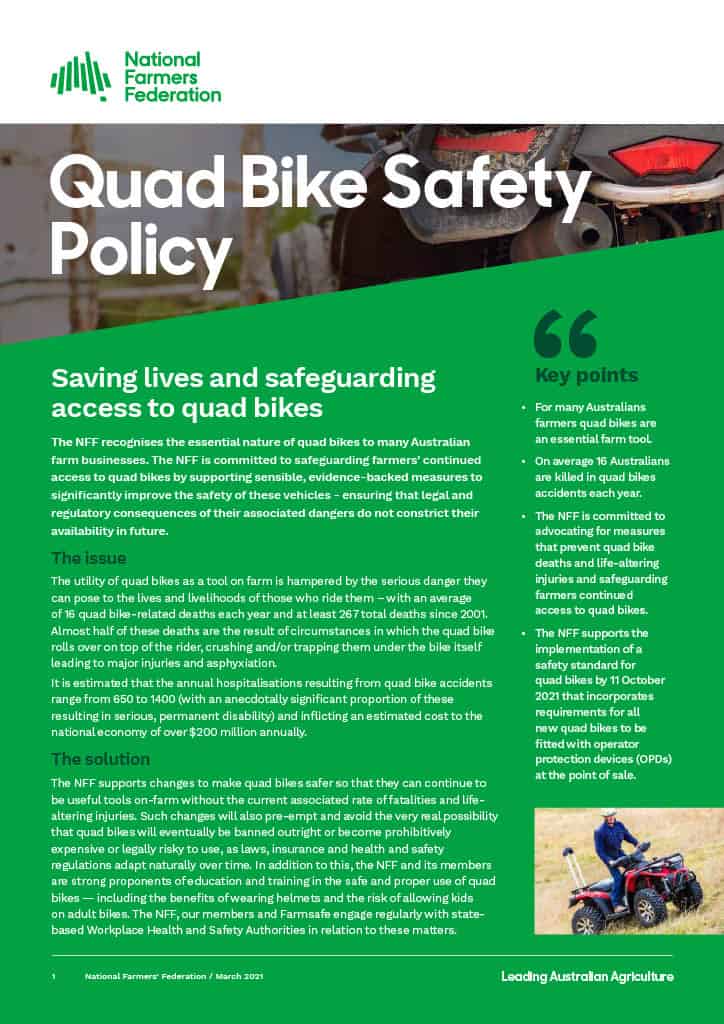
Quad bikes are an important piece of farm machinery, but they are also the leading cause of on-farm vehicle-related deaths in Australia.
Overseas workers play an important role in Australian agriculture, helping farmers address labour shortages when local workers are difficult to access.
Improving the visibility of an on-farm career pathway and enhancing the attractiveness of a career in agriculture is considered crucial in addressing the current workforce challenges faced by this industry, particularly when it comes to attracting new entrants.
In collaboration with Skills Insight, the NFF has been assisting research into the feasibility of a trade apprenticeship in agriculture and what a potential apprenticeship model could look like for the industry. In April 2024, the Ag Trade Apprenticeship Feasibility Report was published.
Recommendations for an agricultural trade pathway have been made by the Agricultural Workforce Working Group, the National Agricultural Labour Advisory Committee in the National Agriculture Workforce Strategy, and the NFF in the 2030 Roadmap.
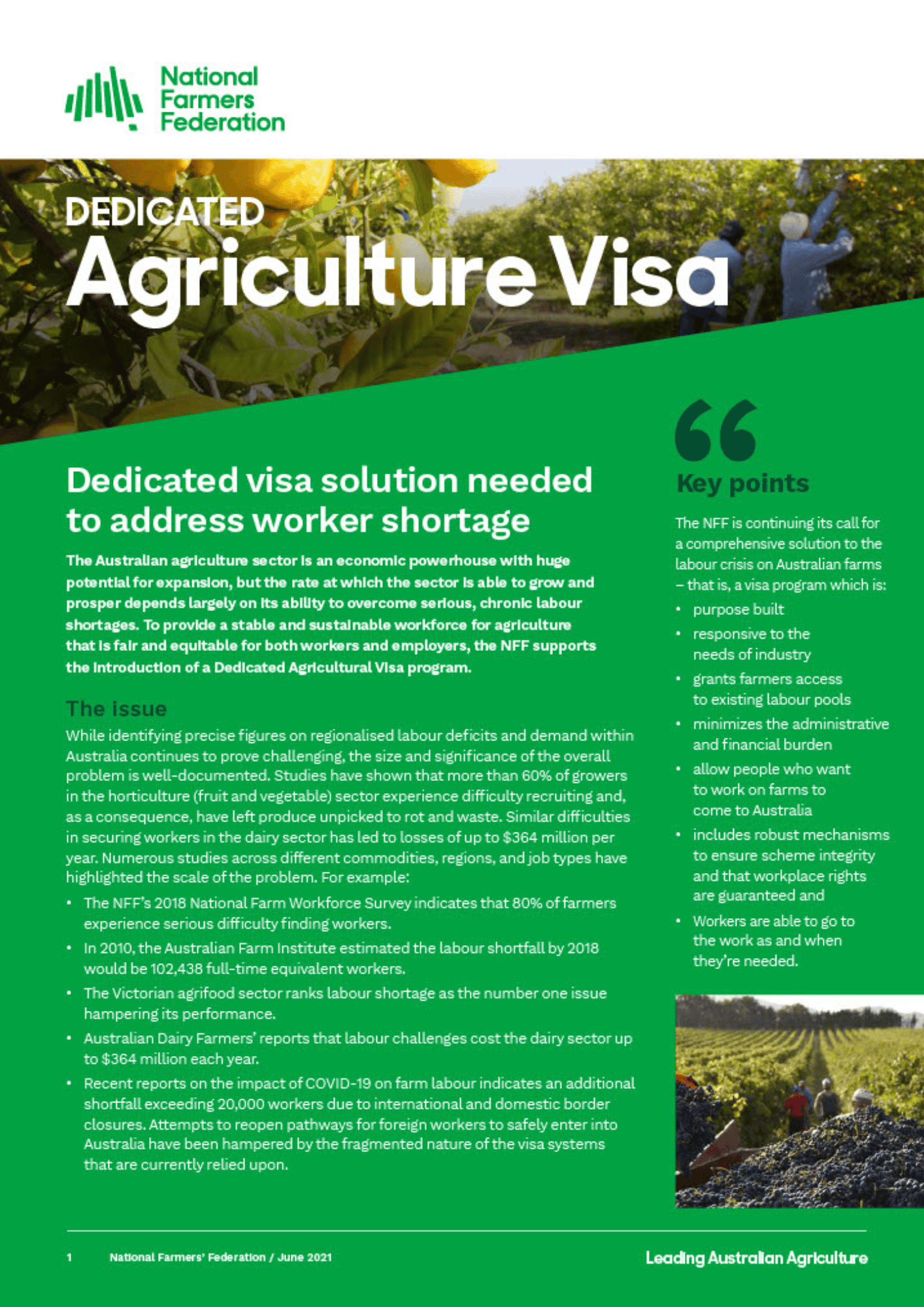
The NFF supports the introduction of a dedicated Agriculture Visa. The Australian agriculture sector is an economic powerhouse with huge potential for expansion, but the rate at which the sector is able to grow and prosper depends largely on its ability to overcome serious, chronic labour shortages.
To provide a stable and sustainable workforce for agriculture that is fair and equitable for both workers and employers, the NFF supports the introduction of a Dedicated Agricultural Visa program.
Studies have shown over 60% of growers in the horticulture sector experience difficulty recruiting and, as a consequence, have left produce unpicked to rot and waste. Similar difficulties in securing workers in the dairy sector has led to losses of up to $364 million per year. Numerous studies across different commodities, regions, and job types have highlighted the scale of the problem.
The consequence of failing to implement an appropriate visa solution is that the supply of food and fibre products produced by Australian farms will be constricted and prices for everyday Australians will go up.
Ensuring the safety of Australian farmers and farming families is a priority for the NFF. A founding member of Farmsafe Australia and a proud supporter of National Farm Safety Week, the NFF shares the Farmsafe vision to improve the wellbeing and productivity of Australian agriculture through enhanced health and safety awareness and practices.
The NFF believes we all need to work together to significantly decrease the incidence of injury and fatality on Australian farms.
For more on Farmsafe or the National Farm Safety Week, visit the Farmsafe Australia website.
The NFF represents the farming sector across a broad range of industrial and workplace relations matters, including annual wage reviews, tribunal decisions, workplace reforms, regulation and flexible employment arrangements. It also advocates for practical measures to address the chronic labour shortages affecting regional Australia.
This work includes submissions on proposed legislative changes and contributing to key advisory bodies, including the Ministerial Consultative Council on Workplace Relations and the Ministerial Advisory Council on Skilled Migration.
The NFF recognises the essential nature of quad bikes to many Australian farm businesses. Quad bikes are an important piece of farm machinery, but they are also the leading cause of on-farm vehicle-related deaths in Australia, and the main cause of fatal injuries in children aged 5-14 on farms.
The NFF is committed to safeguarding farmers’ continued access to quad bikes by supporting sensible, evidence-backed measures to significantly improve the safety of these vehicles – ensuring that legal and regulatory consequences of their associated dangers do not constrict their availability in future.
Overseas workers play a small but important role in Australian agriculture, helping farmers address labour shortages during peak periods when local workers are difficult to access. Migration programs are designed to provide a secondary source of labour, with employers required to seek Australian workers first before filling remaining vacancies with overseas workers where necessary.
In addition to skilled migrants, thousands of backpackers arrive in Australia as working holiday makers and contribute to the agricultural workforce while travelling around the country. Through the Pacific Australia Labour Mobility (PALM) scheme, workers from participating Pacific countries, including Samoa, Papua New Guinea and Fiji, are mobilised to Australia to help address workforce shortages in the agricultural sector.
You can visit the PALM scheme website to learn how to become an approved employer.
The Working Holiday Maker program also supports industries such as agriculture by allowing eligible participants to apply for a second visa after completing specified work in regional Australia.
The NFF calls on the Australian Government to ensure that the proposed capital gains tax (CGT) changes in the Treasury Laws Amendment (Tax Reform No. 1) Bill 2026 do not
The House of Representatives Standing Committee on Employment, Workplace Relations Skills and Training has been commissioned by the Minister for Workplace Relations Amanda Rishworth to conduct an inquiry into the
The Minister for Workplace Relations Amanda Rishworth has commissioned a review into the Closing the Loopholes Legislation. The review is being conducted by a former member of the Fair Work Commission
The NFF has long supported measures to improve train visibility and to enhance level-crossing safety across rural and regional Australia. The NFF supports positive steps taken in the draft Standard
The National Farmers’ Federation acknowledges today’s Fair Work Commission decision and will review the detail of the determination. NFF Chief Executive Officer Michael Guerin said the decision comes at a
The National Farmers’ Federation (NFF) has welcomed the Federal Government’s move today to release proposals on extending Australia’s Right to Repair laws to agricultural machinery. NFF President Hamish McIntyre said
Comments attributable to National Farmers’ Federation President, Hamish McIntyre The Combatting Antisemitism, Hate and Extremism (Firearms and Customs Laws) Bill 2026 passed Parliament last night as expected, without amendment. We
The National Farmers’ Federation says its 2026–27 Pre-Budget Submission is not a bid for short-term sugar hits, but a practical blueprint for long-term investments Australia needs. With the Treasurer signalling