
The Australian Farm Data Code (the Code) aims to promote adoption of digital technology, by ensuring that farmers have comfort in how their data is used, managed, and shared. The Code was developed and adopted by the National Farmers’ Federation (NFF) in consultation with industry, with support from the Australian Government, and has received investment under the Data Sharing Initiative project (DOI: 10.47486/DC102) from the Australian Research Data Commons (ARDC). The ARDC is funded by the National Collaborative Research Infrastructure Strategy (NCRIS).

The Code is intended to inform the data management policies of product and service providers who manage data on behalf of farmers. It is also a yardstick by which farmers can evaluate the data terms and policies of those providers.
Benefits to farmers include:
Benefits for service providers include:
For an informative overview of the Farm Data Code, take a monent to watch our short film. For detailed information about the Code, scroll through the menu of pages for assessment & certification, providers, complaints and notices, the Farm Data Code register and our privacy policy.
The Code is a voluntary code of conduct, and all product and service providers who manage farm data on behalf of farmers, either directly or further down the supply chain, are encouraged to comply with the Code’s principles.
Providers who have a direct contractual relationship with farmers and manage farm data, are eligible for an independent assessment by the NFF of their data terms and policies against the Code. Providers who fully comply with the Code are eligible to be certified by the NFF.
Read more about Assessment and Certification against the Code.
In future, certification will be opened up to any entity that is managing farm data.
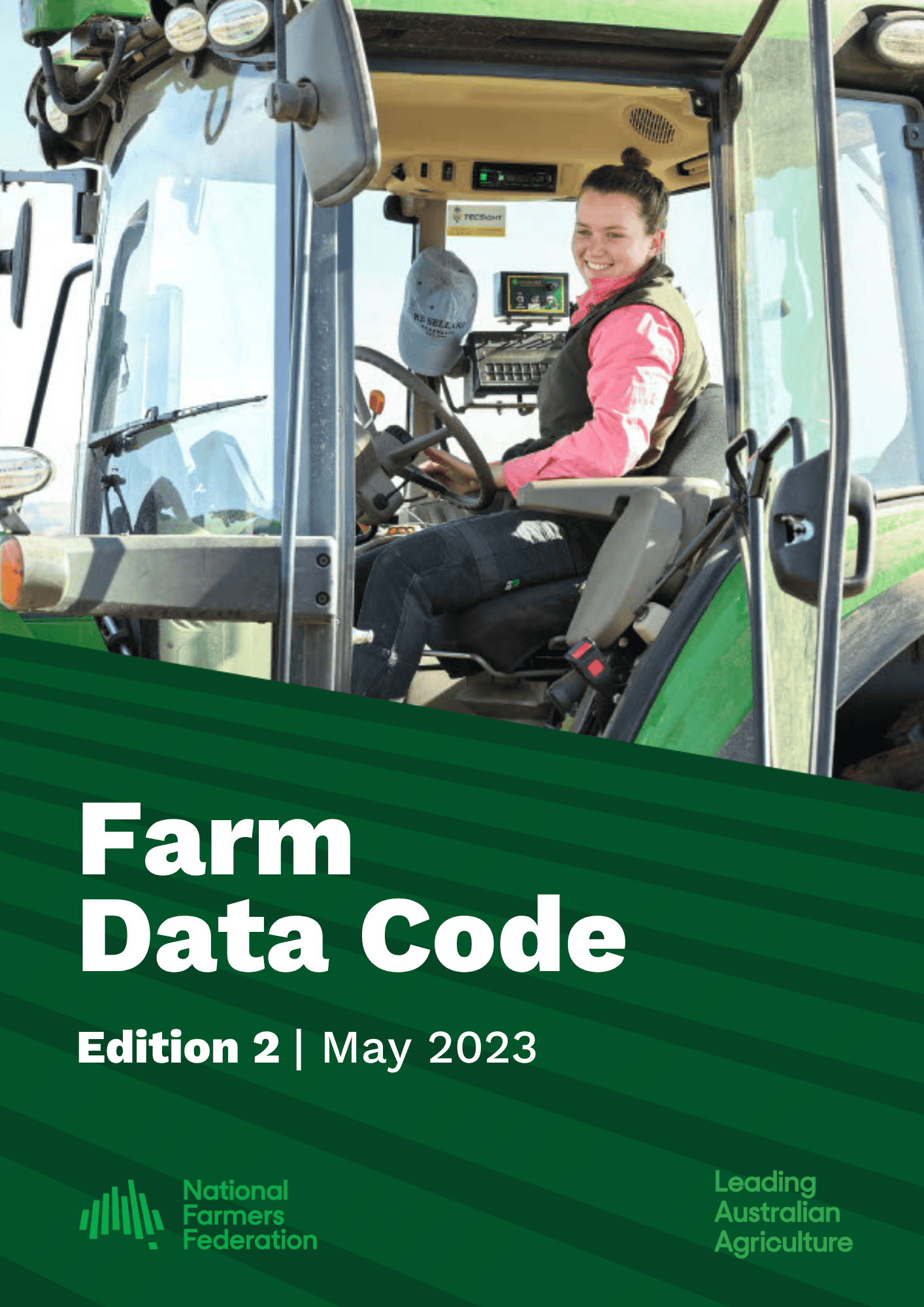
The Farm Data Code was funded by the Australian Government, and developed by the National Farmers’ Federation Farm Data Working Group – bringing together farmers, researchers, industry experts and technology providers.
Members of the Farm Data Working Group (active Dec 2021 – Feb 2023):
> Andrea Koch, DigiSoil (Chair)
> Adrian Roles, NSW Farmers
> Ben Kelly, John Deere
> Cameron Scadding, Source Certain
> Charles Thomas, National Farmers’ Federation
> Hamish Munro, Pairtree Intelligence
> Irene Sobotta, MLA Integrity Systems
> Julian Butler, Telstra
> Leanne Wiseman, Griffith University
> Leighton Wilksch, AgByte
> Meredith Conaty, CRDC
> Nick Bryant, Agratel
> Oli Madgett, Platfarm
> Peter Leonard, UNSW
> Peter Thompson, Echo Farm
> Phillip Guthrie, Nine Creeks Consulting
> Richard Heath, Australian Farm Institute
> Robert Bramley, CSIRO
> Robert Davies, Telstra
During the development of the Code, the Farm Data Working Group was the first point of consultation, followed by community consultation with farmers and industry. Following its initial release, the Code is now subject to regular reviews to adapt it to industry changes.
For ongoing reviews of the Code, the NFF will consult with the wider farmer and industry community, which will include NFF members, agronomists, industry experts, technology providers, research institutions, and government.
The Farm Data Code v2 defines farm data as:
“Any data relating to the operations, conditions or other characteristics of a farm, that is: produced by the Farmer or their staff/contractors/equipment; or created/packaged/acquired at the request of the farmer (i.e. farmer permissioned its collection), and/or in the provision of a service, and is specific to their farm; or produced on the farm.
Farm Data can include raw/unprocessed data, processed data (cleansed, standardised, or otherwise transformed), data that is part of an aggregated dataset, derived data, and new data created about the farmer/farm business or its products, if it fits the above criteria. Examples of Farm Data include (but are not limited to): production data; sensor data; soil data; climate data; transaction data; environmental data; data from monitors, machinery, and other tools; and research data originating from a farm (research is not considered to be a service).”
Data can be valuable. The value of farm data can depend on many variables including its quality, length of time it’s been tracked for, and relevance to a particular context.
The value of aggregated data from many farms can be even more so valuable, as it can be used to train algorithms. If farmers are contributing their data to aggregated datasets from which value is then derived by service providers, then farmers should be able to get some value back for their contribution, and the Farm Data Code addresses this.
When farm data is shared with technology service providers, it can inform improvements to technology systems, which then produce better information for farmers. Sharing data can also foster collaboration within our industry.
Australian farmers are world leaders in adopting technology and innovating. We’ve seen the uptake of agricultural technology (“agtech”) increase over the last decade, but that has not been without risk. Farm data has in the past been shared with third parties, disadvantaging farmers in the process. Long and complex terms and conditions are difficult to read, and biased to protect the service provider. The Farm Data Code seeks to build and support trust in data sharing by setting best practice principles for data management to protect farmers.
In Australia data cannot be legally owned, so instead we refer to farmer control over data. The Farm Data Code requires that the farmer has the right to have their identifying farm data deleted. However, farmers have less rights to control non-identifying farm data, and cannot request for this to be deleted.
The Privacy Act (1988) only relates to personal information and not to farm business and operational data. The Farm Data Code’s principles are based on the Privacy Act’s Australian Privacy Principles, as well as other international data protection laws and codes: European General Data Protection Regulation (GDPR), U.S. Ag Data Transparent code, EU Code of Conduct on agricultural data-sharing, and NZ’s Farm Data Code of Practice.
Data, however valuable, is generally not recognised under Australian laws (including copyright law) as property capable of being owned. Much farm data is not owned by the farmer conducting the farm operations to which that data relates. In some limited circumstances, data relating to farmers is protected under data privacy laws as data about individuals. Data privacy laws do not protect most data about farm operations. However, data that is not known to the public may be protected as confidential (trade secret) information.
Uses of data by service providers may also be controlled through contractual commitments given to farmers by service providers that handle farm data. The Farm Data Code is designed to promote best practices in collection, use and sharing of farm data through uplift in contractual commitments given to farmers by service providers.
The Farm Data Code is also designed to ensure that these best practices are applied:
The US and NZ Data Codes and certifications/accreditations focus on transparency over Providers’ data practices, while NFF’s Farm Data Code goes beyond transparency to set a minimum standard for how Farm Data should be managed.
The Precision to Decision (P2D) report published in 2017 identified a $100B opportunity for agriculture. It also identified trust in sharing data as a barrier to uptake of agricultural technology, and therefore a barrier to the realisation of the $100B opportunity. In response, the Farm Data Code was developed and launched in 2020.
The Farm Data Code applies to service providers who have a contractual relationship with a farmer, however any organisation handling data about farmers and farm operations is welcome to use the Code. A provider (as per the Farm Data Code v2) is defined as “any entity with a direct contractual relationship (written or verbal) with a farm business, which collects, interprets or manages Farm Data in the course of that relationship. Providers include but are not limited to: technology providers, research institutions, government bodies.”
The Farm Data Code currently addresses a direct, contractual relationship between a farmer and a service provider. The reason for this is that contract law is the only legal platform that allows for the enforcement of agreements around the generation, use and sharing of data.
Downstream entities who handle farm data are not in scope for v2 of the Farm Data Code, however the Farm Data Code will evolve and these downstream data relationships will come into scope through a future review.
We strongly encourage entities, who are outside the Farm Data Code’ current scope, to act in good faith and seek to adhere to the principles of the Code, as a contribution to raising the bar around data governance for farm data.
The Farm Data Code requires transparency over uses of data, and that farmers need to provide explicit consent to how their farm data is collected, used, managed, and shared. It does not specifically prohibit specific uses, though it does require that farm data is not used to the detriment of farmers.
The Farm Data Code cannot protect farmers from the capture of images from off-farm, but it can promote the ethical use of it.
Providers who capture or use remote sensing satellite data are encouraged to comply with the Farm Data Code, and be certified against it.
As more private companies take satellite images, this impacts everyone’s privacy. Global governments have been slow to react to the privacy issues that come along with remote sensing, and a national approach is required.
The NFF welcomes feedback on the Code at any time. Simply contact us at farmdatacode@nff.org.au to have your say.
Australian Farm Data Code Edition 1 Published Feb 2020
Copyright © 2026 · Created by the National Farmers' Federation