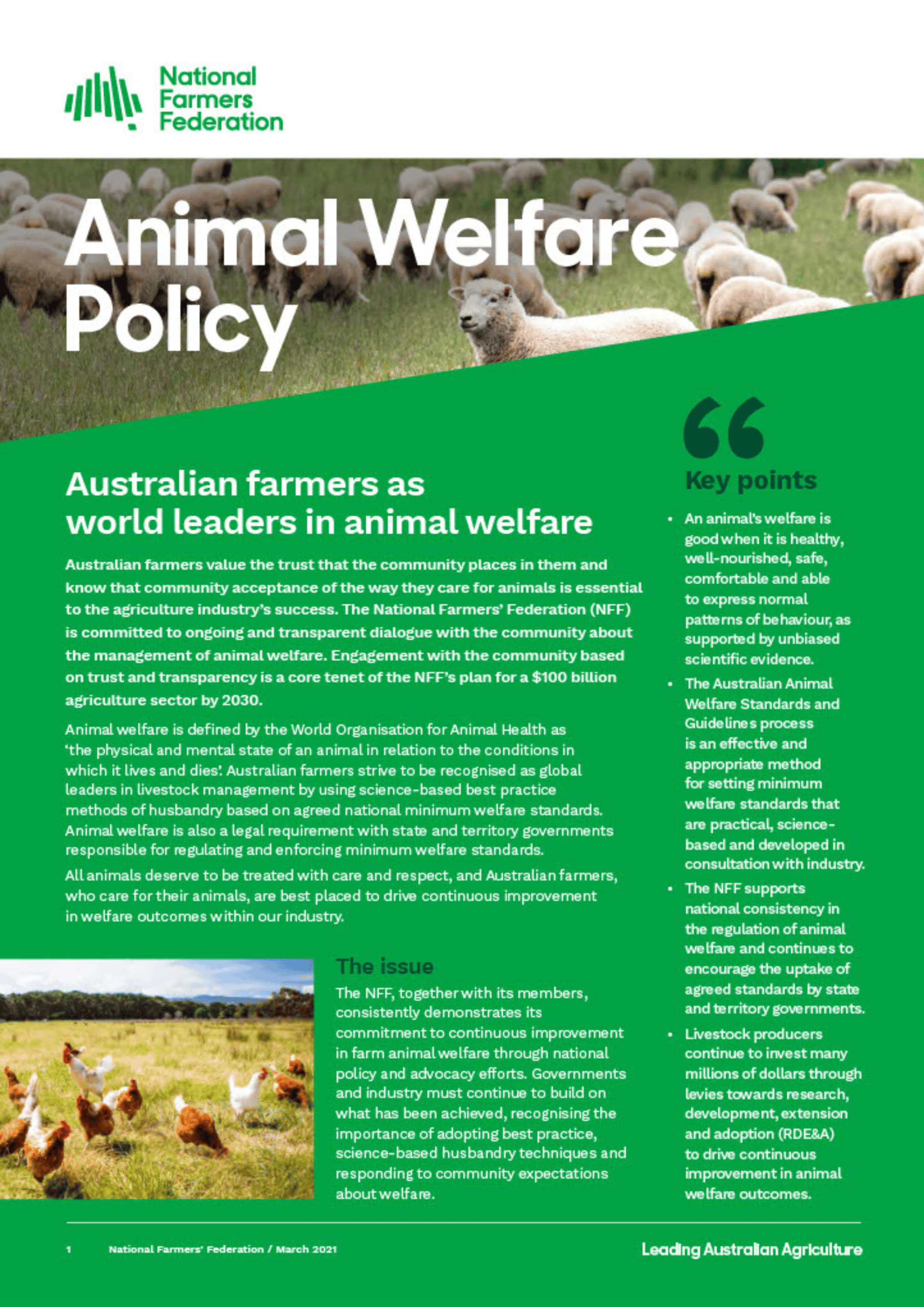
Animal Welfare Policy
Australian farmers value the trust that the community places in them and know that community acceptance of the way they care for animals is essential to the agriculture industry’s success.


NATIONAL FARMERS' FEDERATION advocacy
Australian agriculture is committed to continuous improvement in animal welfare & a robust, science-based biosecurity system that protects Australia from the damaging impact of pests and diseases.
Australian farmers are renowned for their innovation and adoption of world-class operating standards. Farmers take seriously our responsibility to consumers and the community. Healthy animals and excellence in animal care is not only the right thing to do, it is integral to productive farming practices.
To continuously improve animal husbandry and to develop best practice for production animals, the National Farmers’ Federation (NFF) encourages collaboration, between farmers, government and the community. The NFF is committed to its responsibility to be leaders in animal welfare for commercial livestock and production animals.
Protecting Australian livestock and crops from pests and diseases, is essential to productivity and underpins the competitiveness of Australian produce overseas. A strong, robust and science based approach to biosecurity is essential to the farm sector’s continued growth.

Australian farmers value the trust that the community places in them and know that community acceptance of the way they care for animals is essential to the agriculture industry’s success.
The NFF is committed to ongoing and transparent dialogue with the community about the management of animal welfare. Engagement with the community based on trust and transparency is a core tenet of the NFF’s plan for a $100 billion agriculture sector by 2030.
Animal welfare is defined by the World Organisation for Animal Health as ‘the physical and mental state of an animal in relation to the conditions in which it lives and dies’.
Australian farmers strive to be recognised as global leaders in livestock management by using science-based best practice methods of husbandry based on agreed national minimum welfare standards.
Animal welfare is also a legal requirement with state and territory governments responsible for regulating and enforcing minimum welfare standards. All animals deserve to be treated with care and respect, and Australian farmers, who care for their animals, are best placed to drive continuous improvement in welfare outcomes within our industry.
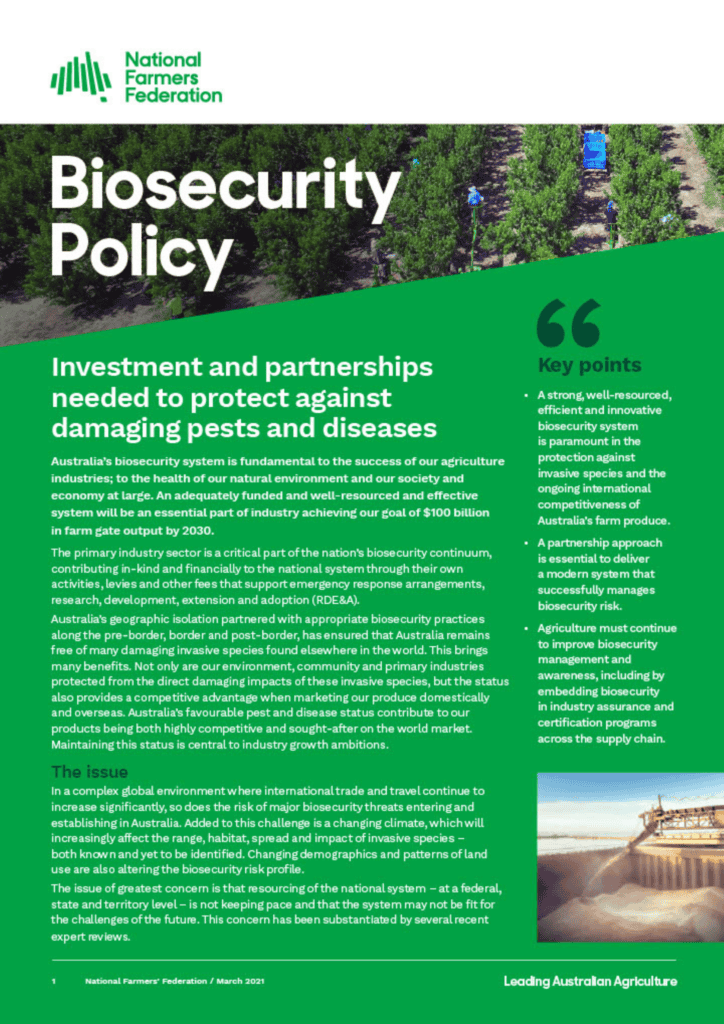
Australia’s biosecurity system is fundamental to the success of our agriculture industries, to the health of our natural environment, and our society and economy at large. An adequately funded, well-resourced and effective system will be an essential part of industry achieving our goal of $100 billion in farm gate output by 2030.
The primary industry sector is a critical part of the nation’s biosecurity continuum, contributing in-kind and financially to the national system through their own activities, levies and other fees that support emergency response arrangements, research, development, extension and adoption (RDE&A).
Australia’s geographic isolation partnered with appropriate biosecurity practices along the pre-border, border and post-border, has ensured that Australia remains free of many damaging invasive species found elsewhere in the world. This brings many benefits. Not only are our environment, community and primary industries protected from the direct damaging impacts of these invasive species, but the status also provides a competitive advantage when marketing our produce domestically and overseas.
Australia’s favourable pest and disease status contribute to our products being both highly competitive and sought-after on the world market. Maintaining this status is central to industry growth ambitions.
The NFF is a partner in the Decade of Biosecurity; a program developed under the banner of Biosecurity 2030 to place the spotlight on the importance of biosecurity for all Australians.
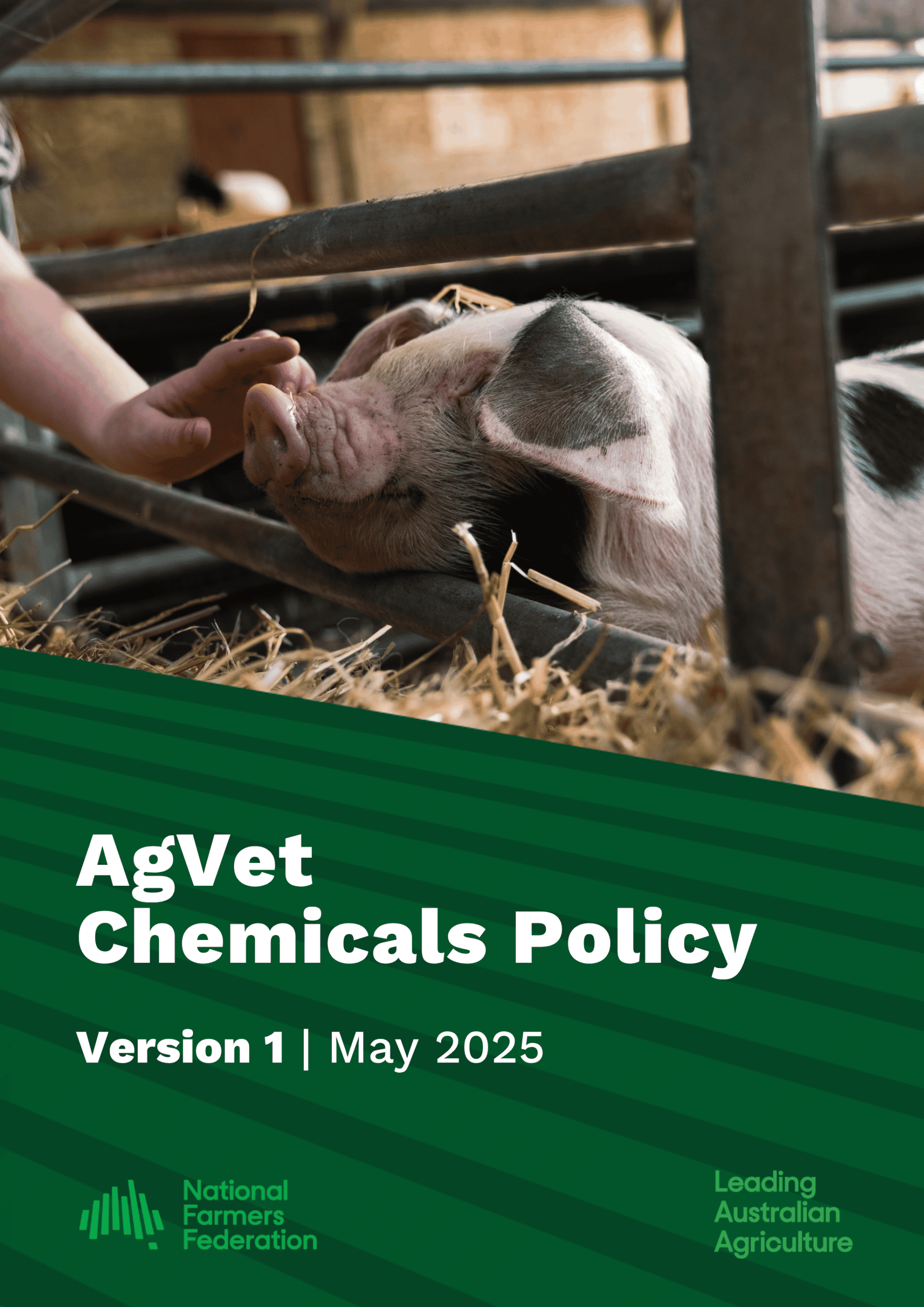
The responsible use, monitoring and storage of farm chemicals is of paramount importance to Australia’s farmers, and must be consistently applied across state borders in line with community expectations about safety and sound environmental management.
The NFF represents one of the largest groups of legitimate chemical users in Australia. The NFF proposes and supports policies, programs and alliances that promote the safe and secure storage, handling, transport and sale of agricultural and veterinary chemicals from the place of manufacture through to the point of sale.
Ensuring that farmers have timely and continued access to safe, effective and innovative ag-vet chemicals is a priority for the NFF and the Farming Systems Committee.
Safe, effective and innovative technologies underpin Australian agriculture’s productivity, sustainability and competitiveness. Timely access to world leading agvet chemicals is critical to achieve the agriculture sector’s ambition of $100 billion in farm gate output by 2030. We work with stakeholders including the Australian Government, the Australian Pesticides And Veterinary Medicines Authority (APVMA), Animal Medicines Australia and CropLife Australia to ensure Australian farmers have the technology and tools they need to protect and manage pests and diseases and increase productivity.
Ensuring access to finance to support small businesses, including farm businesses, is of vital importance to the agricultural sector and rural communities, ensuring these businesses can continue to grow their contribution to employment and the economy.
At the same time, rural debt levels have increased significantly in the last decade – rising by over 85 percent since 2002-03. The rising debt is due in part to prolonged drought followed by flooding rains, and also investments in on-farm capital works as farmers look to improve productivity.
While these investments in capital works should hold farmers in good stead into the future, total farm debt levels at above $60 billion place the agricultural sector at considerable exposure to increasing credit costs. Should the banking sector withdraw its support of the agricultural sector and aggressively foreclose on rural debt, there is potential for regional land prices to fall.
Tightening monetary policies are also having an increasing impact on Australian farmers and posing challenges for the agricultural sector. The NFF believes there is a need to build competition and transparency in the banking sector, improve the understanding by the Reserve Bank of Australia of regional economic conditions, revisit tax based investment mechanisms for regional Australia, and build the education and awareness of risk management tools for farmers.
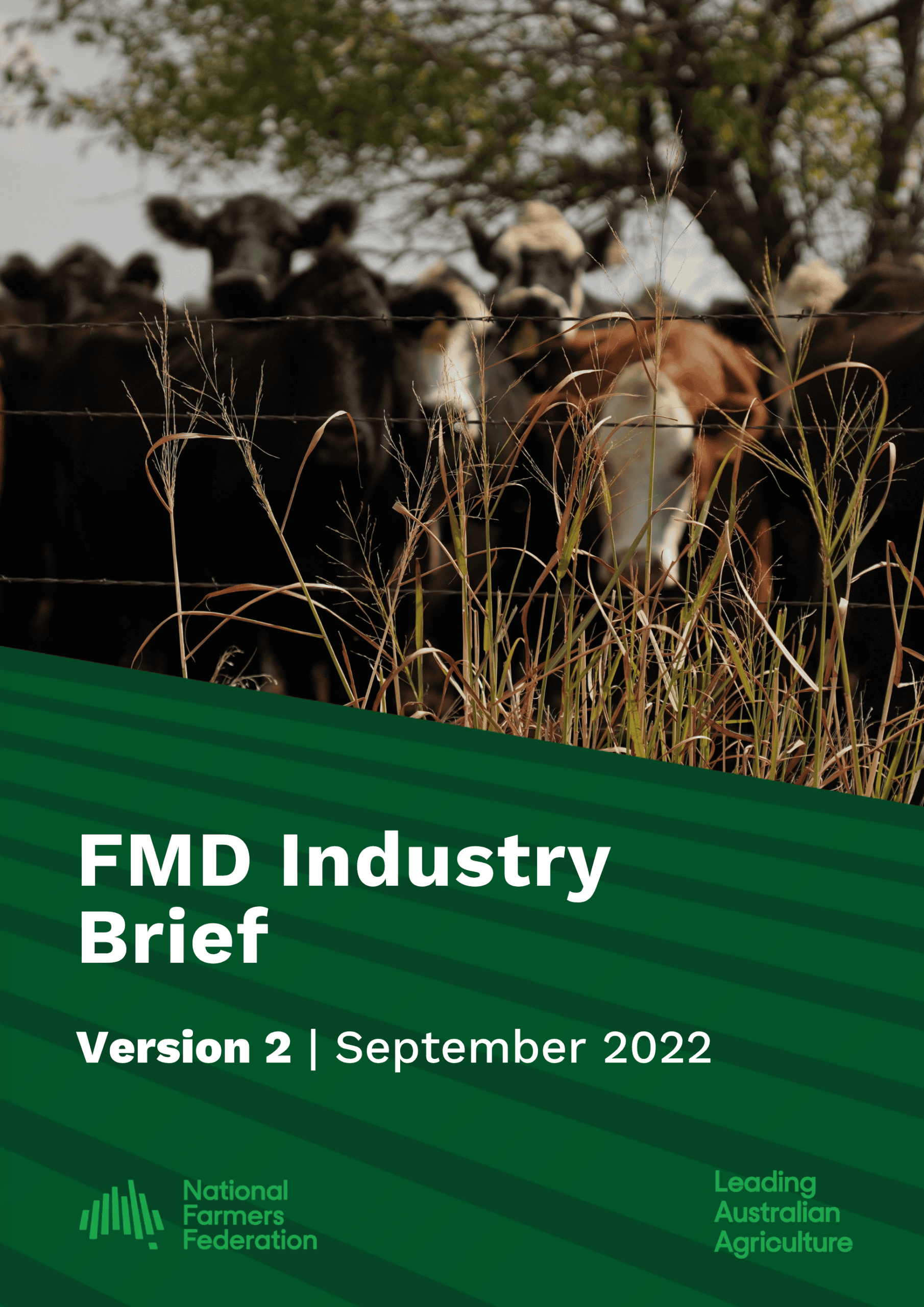
Foot & Mouth Disease (FMD) is a highly contagious animal viral disease that affects cloven-hoofed animals such as cattle, sheep, goats and pigs. It has significant animal health and welfare implications and much of Australia’s market access relies on maintaining our FMD-free status.
Foot-and-mouth disease (FMD) remains one of the most significant biosecurity threats facing Australian agriculture. While Australia remains free of FMD, outbreaks in a number of countries overseas, including regions close to Australia, continue to highlight the ongoing risk of an incursion.
Australia maintains strict border controls, surveillance and preparedness measures to minimise the risk; however, industry and government remain vigilant due to the highly contagious nature of the disease and the potentially severe economic impacts of an outbreak.
Free trade agreements are vitally important to Australian agriculture. More than 80% of Australia’s farm exports go to countries which have signed FTAs with Australia.
The European Union remains one of the few unrealised opportunities with respect to new FTAs.
The success of Australian agriculture is heavily linked to international trade. More than 70% of our farm production is exported. Unfortunately, recent multilateral efforts to lower barriers to trade have struggled to make an impact.
As a result, free trade agreements (FTAs) have become the main tool for driving trade liberalisation.
The NFF is calling on the Federal Government to strike a deal with the EU that provides Australia’s farm commodities with tariff-free and quota-free access to the EU market.
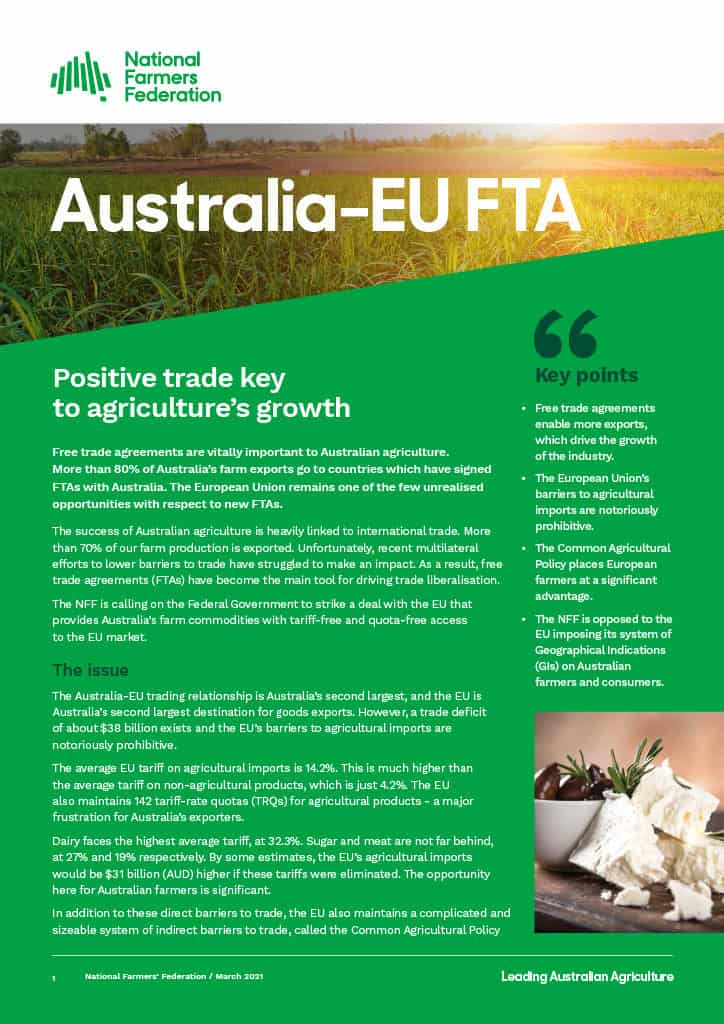
The Australian livestock export industry has undergone major changes over the last several years, as a result of the ABC Four Corners report into live exports in 2012, the Government suspension and the subsequent resumption of trade.
At the heart of these changes has been ensuring continuous improvements in animal welfare.
The suspension of the livestock export industry impacted on many families and communities in Northern Australia, and the livestock industry is committed to ensuring we continue to deliver increased improvements in animal welfare in line with regulatory requirements and social expectations.
As a result, the industry worked closely with governments and key stakeholders to develop a system that protects the welfare of exported livestock. This system, the Exporter Supply Chain Assurance System (ESCAS), is an approved and independently audited system that meets international animal welfare standards, safeguarding the welfare of exported Australian animals.
The industry strongly supports ESCAS through the development and extension of Standard Operating Procedures that align with the World Organisation for Animal Health (OIE) animal welfare requirements. This support includes training, education and technical advice developed by industry and delivered by locally based animal welfare officers.
The new system has required significant investment by both Australian and Indonesian industries and demonstrates the serious commitment of exporters and importers to getting the system right and ensuring the right welfare outcomes for Australian livestock.
The NFF regards competition within the marketplace as a major driver of industry innovation, investment and international competitiveness. It is critical that competition laws are effective at maintaining and improving competition across the agricultural supply chain.
Australia’s current competition policy framework does not adequately protect farmers. Farmers are subject to unfair and anti-competitive commercial practices Current legislation fails to prohibit such behaviours.
The effect Is the unfair diminishing of the profitability and viability of some farm businesses. Current competition law has proven ineffective at protecting farmers from harmful behaviour and forced them to accept commercial terms that transfer risks and responsibilities that should be held elsewhere. In some cases this leaves farmers unable to operate profitable businesses.
Commercial arrangements in perishable food supply chains hinder the longterm productivity growth of the industry by deterring productivity-enhancing investments made by farm businesses.
Often these investments will not be made because the producer’s supply arrangements leave the farm business too uncertain of its future revenue or provides the farm business with such a small portion of revenue that such investments are not viable.
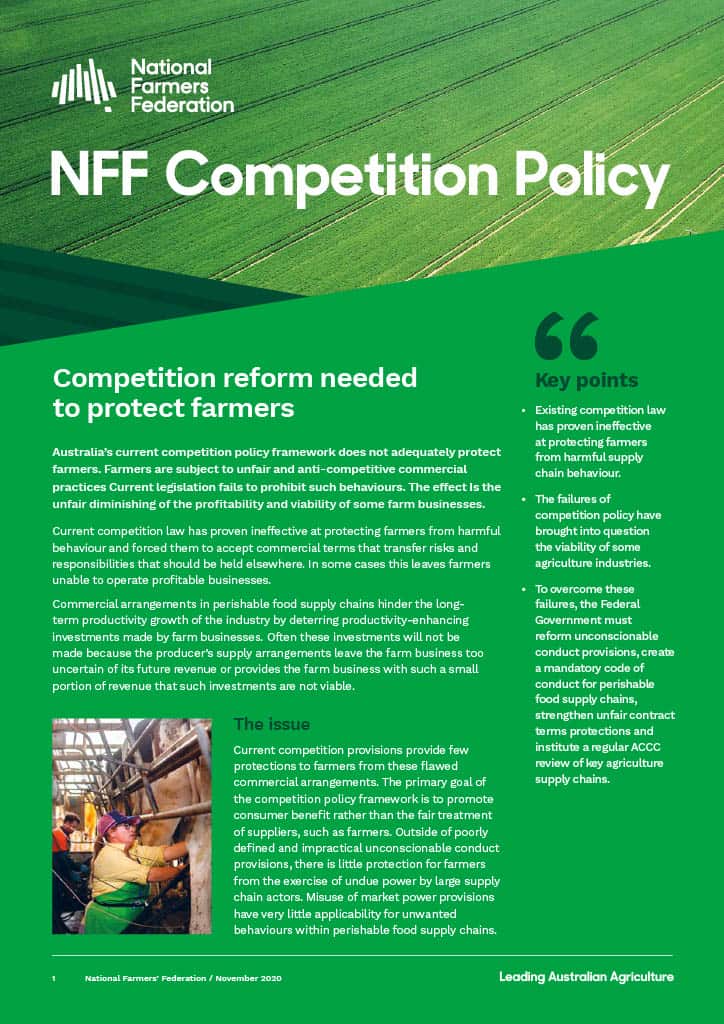
Australian farmers value the trust that the community places in them and know that community acceptance of the way they care for animals is essential to the agriculture industry’s success.
While the National Farmers’ Federation supports ongoing efforts to ensure our biosecurity system is appropriately resourced, we oppose the proposed Biosecurity Protection Levy principally due to concerns over the specific
The National Farmers’ Federation has welcomed pragmatic and proactive action by the Federal Government to protect Australia’s bovine industry from the serious risk of lumpy skin disease. Lumpy skin disease
Copyright © 2026 · Created by the National Farmers' Federation